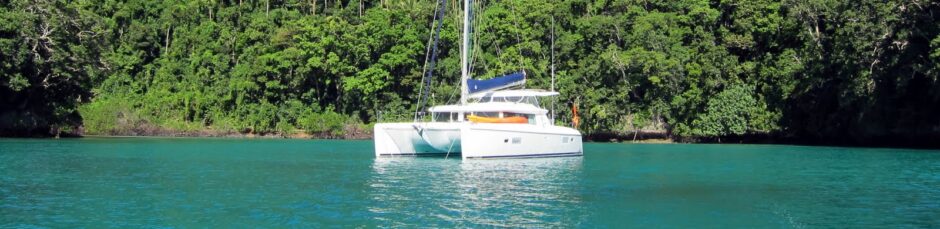
First full day in Fatu Hiva

Waking up in Hanavave and taking in the surroundings makes all the effort of getting here worthwhile. The place is astounding. It has to be noted though that this is the first land for the wind which has crossed nearly 4,000 miles of sea from South America to the east. With 3,500 feet peaks the air is pushed up and the moisture condenses giving a lot of cloud and occasional rain.

When we woke it was quite overcast so we planned to go ashore in the afternoon after we’d done some boat work. John (and later Helen after she’d written her blog) set about the transom steps which had collected a lot of growth during the passage. As hinted at in my last blog I set about the failed components. It was a great relief to find the charger working. On first thought it would have been better the other way round as having abundant fresh water aboard makes a huge difference and we do have alternate ways to charge the house batteries. However, the water maker, being more componentized, will be simpler to fix than a solid state charger.

When I managed to connect and receive emails I received some instructions from Spectra to check a few things out. This involved checking the input side to the high pressure pump including going in the water. I had other things to do in the water so I set about cleaning all the through hulls and checking / cleaning the barnacles. I had feared there would be a lot of scum and barnacles based on what we could see on the steps and one patch of barnacles on the stern. These fears were allayed when I found the hulls largely clean from 3,000nm of sailing. The through hulls had a few barnacles established but no blockages. They were easy to remove with an old chop stick. The barnacles came off with a scraper. I missed a bunch at the bows which John dealt with later.

Having ensured the through hull to the water maker was clear I set about checking all the input lines to the high pressure pump. All appeared ok. It does appear the pump is faulty. It is not clear why it didn’t come on in automatic mode and then when it broke in manual mode. This is a question I have open with Spectra. I must note, again, that the main reason we bought the Spectra water maker was due to the reported responsiveness and quality of their support. They have yet to live down this high reputation. I’m very happy and reassured by the support service we get from them.

Next chore was to ready the dinghy. John cleaned the base out as it had received it’s share of flying fish on the journey here. I’d removed them during passage but they’d probably left their stink. Next the tubes were pumped up to make them firm again. Then on went the outboard, the fuel tank, the anchor/chain/rode and the security chain. The motor started easily enough.

Throughout this time and for the rest of the day we would see some boats leaving and some boats arrive. Merlin, in front of us, left. Helen wanted to move the boat forward so we did. With a working house bank charger I was back to reconditioning the batteries which means bringing them up to full charge and leaving them there for an hour. With 1,320 of Amp hours on the house bank this can take a while even if we’re starting from around 70% to 80% charged. While the house bank charges, so does the drive so moving the boat around on battery power and recharging later added little to our consumption of fuel.

John had started cleaning the sides of the boat. He was a bit embarrassed how scummy they were. We weren’t the only boat like that but it’s always nice to be seen clean. I joined him in this. It’s a slow process. We use green plastic scouring pads to scrub the scum off. Some comes off easily but some takes a lot of scrubbing and this takes a lot of time.

We were in the water until lunch time. I didn’t quite finish my part before being called in. While in the water a French Polynesian customs boat had arrived. The worry for a lot of boats here is that we’re here without clearing in at Hiva Oa. It’s a lot easier to sail from here to there than the other way round so for boats crossing the Pacific stopping off here is natural even though it breaks formalities.

Before could start our soup we were boarded by two gun toking customs officials to do some paper work. It was the usual stuff capturing information about the boat and contents. All went well until we got to the bit about the alcohol aboard. When asked about how much we had we said, quite honestly, we didn’t know but it was about enough to get to New Zealand. They wanted to see it all and made us open up the various hatches and floor boards in the boat. It turns out we are allowed only one bottle of spirits, three bottles of wine and one case of beer each to consume in French Polynesia. The rest can be taken through but to ensure it is, it needs to be bonded. That means placing it in compartments in the boat, drilling holes in the doors/covers and having official customs seals placed through the holes. This was as bad as losing the water maker. We like our bottle of wine with our evening meals and the odd beer after a days hard activity is often welcome. But this allowance was draconian given we expect to be here for nearly three months. At $4 for a bottle of beer ashore and who knows what for wine our supplies were vital.

We didn’t really have anything tucked away in places we were comfortable not declaring so we ended up showing them everything we could think of. That didn’t stop us trying to negotiate a better deal for us and push the boundaries a little. First I negotiated an additional three bottles of wine for the spirits which we don’t drink much of. Then they agreed that a 1 liter carton was ok instead of a 75cl bottle. Then they agreed that our 1.5l bottles were also the same as a smaller bottler. We had about 10 of those. I also asked if we could have a bottle of wine for lunch. That was ok too so we put that one aside. I also left another bottle of wine on the table in front of them separate from our ‘allowed’ pile which went unnoticed. When taking out the boxes of wine from our transoms there were some odds and sods of beer and wine there which the nicer of the customs guys said I could leave. I also had to clear out our ‘beer locker’ leaving only 3 crates – 72 cans/bottles. I was left unattended while doing this so I buried a few under the other stuff kept in the same locker leaving the allowed beer visible. I had a few bottles of beer that were equivalent to 3 or 4 regular bottles. Turned out these counted as one as well so these were swapped into the official allowed pile.

The remaining wine and beer ended up occupying four under seat compartments which were then bonded only to be released once we leave French Polynesia. These seats were themselves full of stuff which had to be removed and found places for – largely those formally occupied by our supplies.

Once this was all done and the customs guys had left we reheated our soup and ate our lunch. We had a quick look around and as a result of our negotiating, honest oversights and a little smoke and mirrors we’ve ended up with just about enough wine and beer available for at least John’s stay with us and perhaps the remainder of our time here if we don’t party.

With the boat in a mess it was now after 2 O’Clock in the afternoon local time and we had yet to go ashore. We collected as many water bottles as we could and soon we were off ashore. We had decided to climb the nearby hill to reach a cross that overlooks the village. When I say ‘hill’ it has to be noted this was somewhere in the region of 2,000 feet high. We followed the paved road out of town which went steeply up the hill. The road looked fairly new and this was proven out by the fact we reached the part where they were laying the surface. The old road was a lot more bumpy, paved many years ago. We walked a little too far. John who was our acting guide had seen a very rough path off the side of the ride near to our destination but had carried on hoping to find something better. Nothing better was found so we descended to the ‘path’. It was a real scramble at first but soon we were walking through a flattened out path through tall grasses and reached the cross. From here we could look down onto the town and the anchorage and at the volcanic escarpment all around us. I had mentioned the weather before. The dampness of the air makes this a very lush place. The view from where we were was breathtaking. It has to be noted that the number of different species of plant and animal life on these South Pacific islands is relatively low. The islands have been around for a relatively short time – probably only a few 10s of millions of years if that. Except for relative recent imports by man, everything else had to make their own way here. Coconuts are of course ubiquitous as they are natural ocean voyagers. A coconut safely wrapped in its husk could travel thousands of miles at ease. Not so for everything else. Plants have a better time as seeds have a small chance of being blown over. Animals have to float over pregnant or pairs which is very unlikely. The exception being birds of which a few species have made it here. Looking around at the lushness of the place, the lack of variety is subtly there too. Not noticeable at first but there once you’re aware.

The walk back down was a lot easier. To support the road works a water container had been set up to collect spring water which in turn had a hose coming out of it. Helen and I showered here as we had the place to ourselves. We also drank our fill. It rained a fair bit on the way down but we didn’t care. We were damp from our shower and hot from our excursions.

As we hit the village we forded the stream to walk through the village rather than the along the ‘main road’. The houses were very simple and the curtains, should I say, colourful. The gardens were largely very well kept and often with beautifully kept hedges and flowers. We ran into a couple of locals selling tapas – locally made art work. The first house gave us three grapefruit and invited us to see their wares. The second house invited us in to see theirs as well as some carvings made by the man of the house. We were interested in the tapas but had no money on us.

Back at the dock we collected the water bottles and filled them from the free fresh water spigot at the dock. With us being unable to use our water maker we plan on using what we have for drinking water and everything else from what we can collect.

On the way back to the boat we stopped off at Kamaya to say hello. When they’d seen the customs boat they’d scarpered ashore and used the time to visit the falls. They’d bumped into the crew of William T Pickett who’d I’d talked to early on in the passage who’d mentioned us and wanted to see us. We agreed to meet up in the morning and go ashore to see a tapa maker at work and arrange an evening meal with one of the locals together.

I then dropped off Helen and John and went over to visit William T Pickett. The two crew were aboard and the captain ashore but I was invited aboard for a chat. They were a young crew doing a circumnavigation being followed by some schools back in Florida using their travels to stimulate course work and exercises. Turned out they had been using our positions given on the net relative to theirs as some sort of class work and no doubt saw our abysmal performance towards the end as a result of our lack of appropriate sails for the winds we had (at least in one piece). Someone ashore had even found our blog and forwarded parts to their boat email so they already knew of some of our tales.

From an educational angle I hope there is an important lesson from our passage blog. We deliberately wrote separate blogs not looking at what each of us wrote until the end. What you got was three different peoples perspectives on the same events. Due to our individual natures you get to see what happened from three different angles. The sum, hopefully, is greater than the individual parts. Professionally (back in real life) I had learned this and greatly valued the differences in opinions that people have on the same subject. Often what people argue over are merely different aspects of a broader picture that neither see. Even the different nuances of what folks say in agreement builds up a broader picture. So listening to others, trying to understand the true meaning of differences is an enlightening process. If I’d learned this early in life I would have been greater for it.

I stayed aboard the William T Pickett for nearly an hour during which time the captain arrived and it got quite dark. We all had stories of the flying fish. One of their crew had been hit by them two or three times while on watch. That must have been nasty and is up there with waking up with one in bed with you.

Back on Dignity I retrieved my emails. I definitely need a new high pressure pump. I also received a response from our agent in Tahiti and we have a way of getting a new part through customs and out the Marquesas. I placed my order with Spectra and asked if we could still try and troubleshoot to identify cause based on the symptoms we had. Either it was the pump failing or there is an outside cause which needs to be identified lest it ruin the new pump.

Dinner was curry accompanied by a can of beer and wine. We’re back on land. Did we just spend 3 weeks sailing?

Posted in Kamaya, Marquesas, William T Pickett | Leave a comment

Helen: Day 22

I woke up for my morning shift to the rumble of the generator. We were motoring. Steve must have decided that our sanity was worth burning some precious fossil fuel. We would reach landfall today. Today today today!

It was still quite dark and gloomy when I took over the helm. The sky was covered in dark ominous looking clouds. Steve said he had to deal with a couple of small squalls but it look like it was clearing up. Checking the sky I noticed that most of the squall clouds had passed us except for one large squall behind us. Looking at the wind direction and the radar it looked like it would just miss us. We were motor sailing at this time. Wing on wing. Sometimes the wind picks up and gives us an extra push.

The wind speed was showing 5 knots.

I suddenly felt the boat surge forward. The sails billowed full. The wind speed now showed 20 knots. Steve rushed out shouting ‘make sure we don’t jibe’. It felt like the boat was about to take off. I DID NOT LIKE THIS! I saw the wind clocking behinds us. We were about to jibe. I went to press the Manuel button to take control of the boat and froze. My mind went blank. I was like a deer staring at headlights. I heard Steve shout at me and then take over the helm. He managed to get control of the boat. I couldn’t move.

Ten minutes later the squall passed us. We had only got the edge of it. It took another half an hour for my heart to calm down. I realised that I’ve never had to control the boat in a crisis situation before. I wasn’t prepared and so panicked. Steve said that will have to be remedied.

After the squall Steve wanted to continued charging up the house bank. Since we were running the generator and the sea was pretty calm he asked if I wanted to do a wash. Oh Yes! Once the washing machine was going, Steve decided he might as well make some water. This was when we discovered there was something wrong with the water maker. Something seriously wrong. Soon after Steve noticed that the batteries weren’t charging. This was when we discovered there was something wrong with the house bank charger. This was getting serious. Then it seemed as if the solar panels weren’t charging either.

During all these unwanted discoveries, the clouds and mist cleared and suddenly I saw the faint outline of land. My stomach did a funny turn. Land ahoy! Land, land, land! It was exciting. But I must admit our excitement was subdued by all the problems starting to pop up on the boat. For me not having a water maker was the worse.

It was about eight hours from land sight to reaching landfall. We watched as the island grew nearer and nearer and the landscape became clearer and clearer. Entering our anchorage was amazing. It was quite beautiful. Stunning really. Almost Jurassic Park. Can’t quite describe it. The only negative things was that there was a lot of other boats here too. Still we saw a couple of old friends who had made it here as well.

After anchoring, zipping up the sail bag, putting away the lines, we cracked open the beer. That first sip was nectar. For dinner we treated ourselves to a BBQ. Ribs and chicken. And of course I had my bottle of wine. By the end of the evening, that three week crossing seemed so long ago!

Posted in At Sea | Leave a comment

Steve: Day 22 – landfall

0nm to go. But what a day!!!!

I was woken by John at 5am for my morning watch. This was ships time. Local time it was 1:30am. A quick scan of the distance to go revealed we must have had a very slow 6 hours. Talking to Helen later I learned she’d even had 30 mins with no wind whatsoever.

We now needed to average nearly 5 knots to make landfall by an hour before sunset and we weren’t making that. As mentioned in my last blog I started off giving the boat a push with the power stored in the drive batteries. We had been cross charging the house bank from the drive bank for the last couple of days without replenishment so after a couple of hours I needed to turn on the genset. I put it in ‘mode 4’ which sends most of the power from the genset to the house and a smaller amount to the drive. This was fine as I wanted to give the house batteries a really good charge.

This all happened as I battled my way through a number of squalls with wind shifting from all angles necessitating quite a few changes to the sails. Sometimes the wind would blow strong enough to keep us well above our desired 5 knots and sometimes not.

After about an hour of charging Helen awoke. Having washed almost everything we still had a few towels to wash and as the seas were still flat, despite the squalls, we could wash these while we had the house power.

The wash went on and I turned on the water maker. This was to be our first problem of the day. The water maker made no water coming up with an error message instead. I power cycled it a few times but with the same results. It appeared that the high pressure pump was not running in automatic mode. There is a manual mode which I’ve never used before. I tried this. The high pressure pump ran in this mode but fresh water was not being produced.

I compiled a long email for Spectra support putting in all the information that I thought may help them in troubleshooting including all the settings I could read. We powered down the genset and the motors so I could email this and our blogs off during the small morning window that we have for sending out emails. Once done I powered up the genset again.

Here we ran into the next problem of the day. The battery charger detected the power being back on but refused to charge the batteries. Not good. John had already been woken by my rummaging around in his room looking at the water maker problem. Now I needed to get under his bunk to examine the charger.

By now we’d sighted land but the thrill of doing so evaded me as I was wrapped up with the gloom of multiple issues.

The troubleshooting guide in the manual I had for the charger did not cover the symptoms I had nor did it cover the particular set of lights I had showing. I wondered if some sort of reset was required. With John at the helm to hand steer I isolated the house batteries for a short while then reconnected them. Checking everything was ok I ran into a third problem. The solar panel controller, which had been charging the house bank (by now it was day time), was no longer registering any charging. I’m glad I’d installed the remote display back in the Caribbean as I would not have seen this. You can imagine my spirits were sinking fast.

To get to the solar controller I had to get inside the starboard transom which also contains some stores and our bicycles (which we’ve hardly ever used). This requires moving the stores and squeezing oneself into a tight space. Looking at the controller it was obvious it had done a factory reset. I had forgotten the password required to go through the initial set up so I had to go and look that up before initializing the unit. Thankfully this worked and we were gaining power from the sunlight.

Around then I had a second thought about the manual mode for the water maker. We put it back into manual mode then instructed the front panel to make water automatically. Hey presto we were making water. Not ideal but having a work around would see us through to a proper fix. My spirits were lifting.

Back to the charger. I verified it still worked as an inverter but try as I might I could find no way to make it charge. One of the indicators suggested there may be a battery voltage issue which was certainly not the case as I was able to measure this independently. Thinking it may be a thermal cut off (despite the thermal cut off light not being lit) I ran a fan over the unit and kept it aired for a couple of hours. No improvement. My current hypothesis is that the voltage sensor in the unit has failed making it think there is a problem. This doesn’t stop the inverting to give us mains power but it perhaps fatally impacts the charging.

After about an hour of making water we suddenly heard a screaming noise coming from the high pressure pump. We quickly had the unit switched off. All further attempts to start the water maker came to no success. Follow up emails were compiled and sent to Spectra.

By now I was exhausted. We’d been on and off motoring, mostly on batteries, but after the many squalls had passed we were left with pretty good winds. As we approached Fatu Hiva the waters became short and choppy putting strain on the boat as it tossed around. I tried to catch up some sleep but that was barely successful.

As we rounded the southern end of the island we established VHF contact with Kamaya. They wanted us to relay a message to the SSB net which was not contactable from the bay. We shut everything down and got onto the net breaking in out of turn before we also lost contact. We got the message through and got back to heading in.

With the problems of the day parked in my mind the rounding of Fatu Hiva was finally enjoyable. The place is so rugged and barren. The volcanic origin has created so many interesting angles and features on the landscape. It almost felt like arriving at the island of King Kong.

The bay of Hanavave (Bay of Virgins) is tucked away and not visible until we were close. Tightly packed into the bay were 23 other sail boats, a few of whom we recognized. The waters were now calm and flat. The folks from Merlin were out in their dinghy and came over to say Hello and let us know a boat had left during the day leaving a spot behind them. That was useful info. We found that spot and anchored in 50 to 60 feet taking 3 attempts to do so.

INSERT_MAP

We saw Tim and Ruth from Kamaya just next to us and were able to shout at each other agreeing to meet up and perhaps go to the waterfall here together.

Then it was down to tidying up the boat, making sure things were sound, retesting the charger (still no good – thermal cut off hypothesis now very weak) getting another email off (about the charger) before finally up a beer to celebrate our arrival. We’ve covered approximately 3,050nm in 21 days and change. Comparing notes with others on the passage we’ve not had the best of it. Our first two days were a struggle to get south. We had some great sailing for nearly 2 weeks (at least John and I thought so) but the last two weeks killed us without the Code Zero in the light weather. Also, boats like Kamaya, stayed further north for a long time staying in the favourable current and getting a better angle on the wind at the end. Having said that, 3,000 odd miles in 21 days is better than planned and fairly respectable. Apart from the Code Zero and until the last morning the only other fault on the trip was a broken cleavis pin. Then came the water maker and the charger out of nowhere in quick succession. Why these happened then with an interval between failures I have no idea.

Relaxing in the bay, drinking our beer and wind with ribs and chicken on the BBQ we were able to enjoy sunset in the most beautiful anchorage we have been in to date. It’s simply stunning. The only downside is sharing the place with so many other boats. Today we’ll go ashore and see the place up close before getting on and cleaning up the boat. Very much looking forward to getting our feet on the ground.

Final words are to wish my father a Happy 80th Birthday. Keep getting better. Hope to Skype soon.

(Now I can go and read all the blogs written by Helen and John during the trip)

PS. It’s now the morning. We’ve had a great nights sleep. I’ve retested the charger. It works !!!!! Maybe it was a thermal overload all the time. I’ve retested the water maker. It doesn’t 🙁

Posted in Kamaya, Marquesas | 1 Comment

John: Day 22/23

Finally Made It!!!!!!!

The last day wasn’t all plain sailing.

I’m sure Steve will explain in greater detail, but the result is that the house charger isn’t working and the water maker is broken.

We sailed around the island to the west side where the anchorage is. It’s beautiful, stunning cliffs, and steep hills covered in lush green foliage and palm trees.

Merlin, a boat that we have seen and heard loads during our travels, were in their dinghy and came to say hello, there are a few boats that we’ve seen about before and some that had just left to move on to other islands. I sure that we’ll bump into them at some point.

We anchored, cracked open some cold beers and started to cook our BBQ. It was delicious.

I had a very nice sleep, the only time I was interrupted was to close my window due to rain and I feel pretty good this morning.

Steve and I will sort out the dinghy so we can go ashore, I think we’re going to trek to a waterfall.

We all have some boat chores to do, I’m sure we’ll work through the list over the next few days.

Posted in At Sea | Leave a comment

Helen: Day 21

We all welcomed day 21 with hope and optimism. Steve confirmed that we should see land by tomorrow morning and make land fall by tomorrow sunset. Tomorrow! What a wonderful word. Today would have been a better word but tomorrow is good enough. All we had to do was average three and half knots for the rest of the trip. Easy peasy. Yeah. Don’t forget we’re in the twilight zone.
In the morning we were doing three and half knots. In the afternoon we were doing two and half knots. In the evening the wind died and stayed dead. During my night watch we were doing one and half knots. The nearer we got to land, the slower the boat got. Would we ever reach land? At the end of my night watch it was 0.8 knots. The ETA showed 74 hours. Thats another three more days. Wasn’t it three days ago that the ETA was three days. Noooooooo!

Posted in At Sea | Leave a comment